
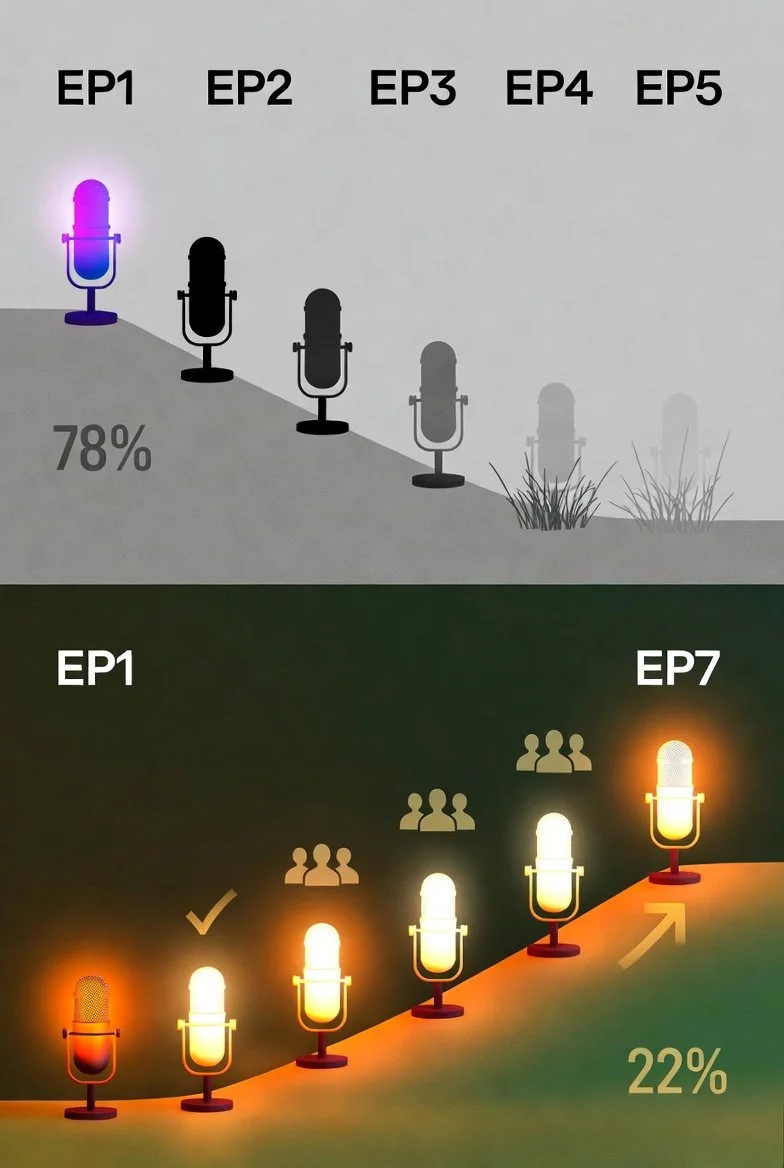
Why 78% of Podcasts Fail Before Episode 7 (And How to Be in the 22%)
78% of podcasts never make it past episode seven.
Not because the content was bad. Not because the hosts quit caring. But because they hit predictable failure modes that no one warned them about.
I've spent 20 years watching podcasts launch with enthusiasm and die quietly (the podcasts, not me). The pattern is always the same. Episode one: polished, energetic, professionally introduced. Episode three: slightly delayed, apologies for the gap. Episode five: "We're experimenting with format." Episode seven: silence.
Then the abandoned Twitter account. The website that still says "new episodes weekly." The LinkedIn profile that quietly removes "podcast host" six months later.
Here's what kills podcasts, and how to avoid becoming part of the statistic.
1. The Consistency Collapse
Symptoms: Irregular publishing schedule, growing gaps between episodes, "we'll be back soon" messages that drag on for months.
Root cause: No production system. You're relying on motivation, which is a terrible strategy for consistency. Motivation gets you through episode one. Systems get you through episode fifty.
Most podcasters approach each episode as a standalone event. They think about it on Monday, record on Wednesday, edit on Thursday, and panic-publish on Friday. This works until life happens. A busy work week. A sick kid. A project deadline. One missed week becomes two, becomes "we're on hiatus," becomes abandoned.
The fix: Batch recording. Record four episodes in a single session. This creates a buffer that survives disruption. At Podcast Studio Glasgow, we regularly book clients for 4-hour sessions where they record an entire month's content. When they leave, they have four edited, broadcast-ready episodes. They can't fall behind because they're already ahead.
The data: Our corporate clients who book monthly recording sessions have a 94% retention rate over the past six months. Clients who book "as needed" have a 31% continuation rate. The difference isn't commitment, it's system design.
Consistency isn't about willpower. It's about making consistency the default option.
2. The Solo Void Syndrome
Symptoms: Talking to yourself feels increasingly awkward, your energy drops as episodes progress, and you ramble because there's no one to redirect you.
Root cause: No real-time feedback loop. Humans are social creatures. We're wired to read facial expressions, respond to questions, and feed off conversational energy. Solo podcasting removes all of that. You're performing for an imaginary audience, and after a few episodes, the weirdness catches up with you.
The fix: Switch to an interview format or add a co-host. This isn't about content, it's about energy management. When you have someone across from you, your brain shifts from "performing a monologue" to "having a conversation." Your energy stabilises. Your pacing improves. You stay engaged because someone else is engaged.
If you're committed to a solo format, you need exceptional self-discipline and a personality type that derives energy from solitary creation. Most people don't have this. That's not a weakness—it's just how humans work.
Why it matters: Energy is contagious through audio. When you're energised, your listener feels it. When you're going through the motions, they feel that too. Dead energy kills podcasts faster than bad content.
3. The Audio Amateur Tell
Symptoms: Listeners leave within 90 seconds. Comments mention that the podcast is "hard to listen to," but they can't explain why. Your analytics show a high drop-off before the first topic even starts.
Root cause: Substandard audio quality that subconsciously signals unprofessionalism. Your listener doesn't think "the audio quality is poor." They think, "This person isn't serious," and click away.
The reality: Your content could cure cancer, but if it sounds like a phone call from 1997, nobody will hear it.
Audio quality creates an immediate judgment of credibility. Listeners give you about eight seconds before their brain decides whether you're worth their time. Poor audio—echoey rooms, background hum, inconsistent volume levels—triggers a "low quality" judgment that your content can't overcome.
The fix: Meet professional audio standards. This means proper microphone technique, treated recording space, consistent levels, and clean editing. You can learn this yourself with about 50 hours of study and £1,500 in equipment, or you can record in a professional studio where these standards are built into the infrastructure.
At Podcast Studio Glasgow, we automatically handle audio standards. You show up, we position the microphones, set the levels, monitor the recording, and deliver broadcast-ready files. You never have to think about 12dB peaks, noise floors, or compression ratios.
Professional audio isn't about perfection. It's about removing the obstacles between your content and your listener's attention.
4. The Promotion Paralysis
Symptoms: You're creating great episodes, but nobody's listening. Your download numbers are stuck. You're asking "why isn't this growing?"
Root cause: You're treating podcast creation like the hard part. Recording is the easy part. Distribution is the hard part.
Most podcasters follow this ratio: 5 hours recording and editing, 30 minutes posting to their host, zero hours promoting. Then they wonder why their brilliant episode got 23 downloads.
The fix: Invert your time investment. Two hours recording, three hours promoting.
Promotion means:
Writing detailed show notes with keywords people actually search for
Creating 3-5 social media clips from each episode
Optimising your episode titles for search intent
Building an email list and actually using it
Cross-promoting with other podcasters in your space
This isn't optional marketing. This is the actual job. The podcast episode is the raw material. The promotion creates the distribution.
Time investment reality check: If you're spending more time recording than promoting, you're building a private audio diary, not a podcast.
5. The Identity Crisis
Symptoms: Your format changes from episode to episode. You're solo one week, interview the next, then a panel discussion. Your listener can't predict what they're getting. You're "figuring it out as you go."
Root cause: You started without a clear positioning. You didn't define who this podcast is for, what transformation it creates, or why someone should care.
The test: Can a stranger explain your podcast in one sentence after listening to any episode?
If your answer is "it depends on which episode they heard," you have an identity crisis.
The fix: Pick one format, one audience, one transformation. Commit for ten episodes minimum. You can't optimise what keeps changing.
This doesn't mean your podcast can't evolve. It means you need a stable foundation to evolve from. Choose your format. Define your listener. Articulate your value. Then stay consistent long enough to see if it works.
Identity isn't limiting. Identity is clarifying. It tells your listener exactly what to expect and whether this podcast is for them.
The PSG Survival Framework
If you want to be in the 22% that survives past episode seven, you need to avoid these five failure modes. Here's how:
Record four episodes before launching. Create a buffer that protects against the consistency collapse. Launch with momentum instead of pressure.
Choose your format and stick to it. Solo, interview, or panel—pick one based on your energy profile and sustainability, not what sounds exciting. Use our format guide if you're uncertain.
Meet the audio quality baseline. Professional audio isn't optional. It's the price of entry. Either invest in learning it properly or use a service that handles it for you.
Batch your production. Don't record weekly. Record monthly. Four episodes in one session create efficiency and consistency that weekly recording can't match.
Make promotion 60% of your effort. Recording is not the job. Distribution is the job. Your content only matters if people hear it.
Most podcasters fail because they treat podcasting like a creative hobby. The 22% that survive treat it like a system that needs operational discipline.
Creativity gets you to episode one. Systems get you to episode fifty.
Skip the failure modes. Book a session at Podcast Studio Glasgow, and we'll help you architect a podcast that survives year one. Free 30-minute strategy session with your first recording. And check out our podcast readiness checklist here.
£75/hour, no hidden costs.