
The Three Podcast Formats: Choose Wrong and You'll Quit in 60 Days
The format you choose isn't about preference. It's about sustainability. Here's how to pick the one you'll actually stick with.
I've watched dozens of podcasters burn out not because their content was weak, but because they chose a format that drained them. The enthusiastic educator who went solo and couldn't sustain the energy week after week. The shy introvert who forced themselves into a panel format and dreaded every recording. The busy professional who chose interviews but couldn't coordinate schedules.
Format isn't a creative decision. It's an operational one.
After 20 years of producing podcasts, I can predict which formats will survive and which will collapse based on three factors: your energy profile, your coordination capacity, and your content goals.
Here's how the three main formats break down, and how to choose the one you'll still be doing in 2026.
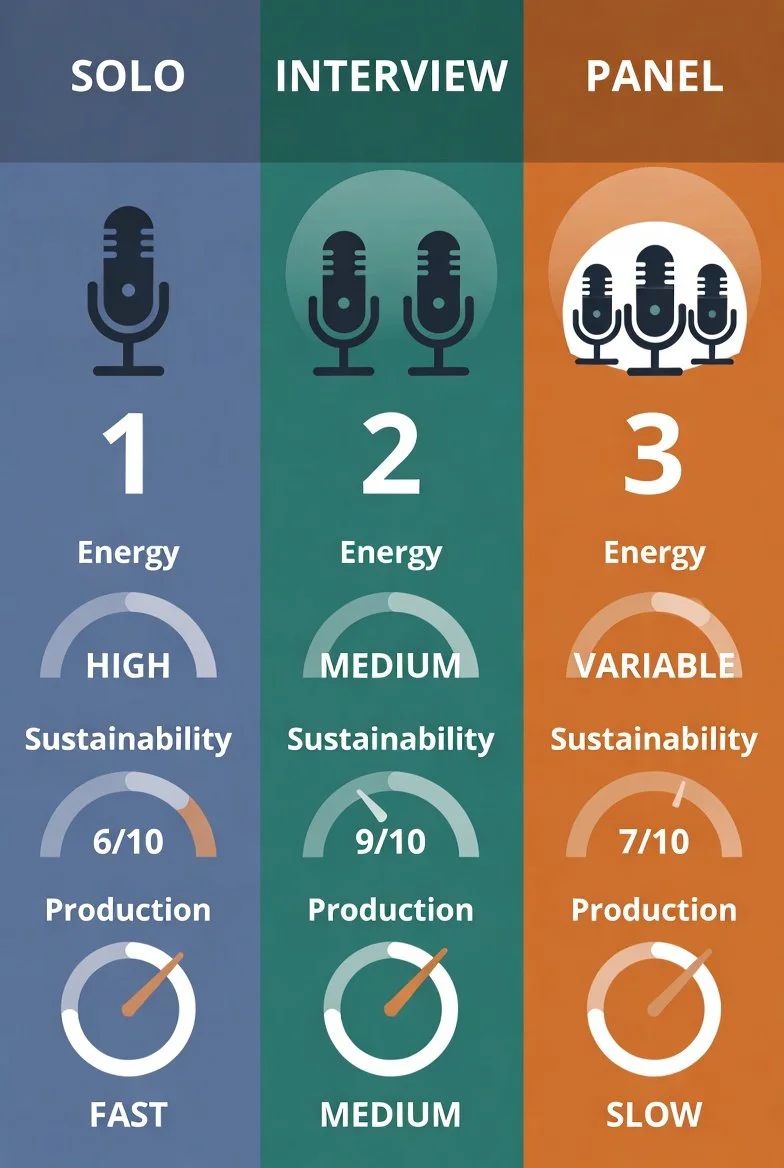
Solo Format: The Energy Test
Best for: Subject matter experts, educators, thought leaders
Energy requirement: HIGH—you're carrying 100% of momentum
Sustainability: 6/10—requires strong self-discipline
Production time: Fastest (no coordination needed)
Listener experience: Intimate, educational, "in your head"
Solo podcasting is deceptively difficult. You're the writer, performer, and energy source. No one is there to bounce ideas off. No one asks clarifying questions. If your energy drops, the episode dies.
The people who succeed with solo formats have a specific personality trait: they can sustain their own enthusiasm without external validation. They're comfortable talking to a microphone for 15 minutes and trusting that someone, somewhere, will find value in it.
The Solo Success Formula:
Keep episodes between 12 and 18 minutes maximum. Longer than that and you're asking your audience to stay engaged with a monologue, which is harder than most podcasters realise.
Teach one thing per episode. Not three things. One. Your listener should be able to explain your main point in a single sentence after listening.
Use the "coffee shop test." If you told this story to someone over coffee, would they stay engaged or start checking their phone? That's your quality bar.
Prepare three examples for every topic you cover. Examples make abstract concepts concrete. Three gives you variety without overwhelming your listener.
Record in the morning when your energy peaks. Solo recording drains you faster than you expect. Don't schedule it at the end of a long workday.
At Podcast Studio Glasgow: We offer teleprompter setups for solo podcasters, which lets you work from bullet points without sounding scripted. Multiple takes are encouraged—there's no guest waiting, so we can get it perfect. We regularly batch four episodes into 90-minute blocks for solo clients.
Interview Format: The Coordination Trade-Off
Best for: Networkers, curious generalists, relationship builders
Energy requirement: MEDIUM—your guest carries 50% of the energy
Sustainability: 9/10—guest variety maintains your interest
Production time: Medium (scheduling is the bottleneck)
Listener experience: Discovery, vicarious learning
The interview format is the most sustainable podcast structure because your guest does half the work. They bring new perspectives, new energy, and new audiences. You're the guide, not the performer.
The trade-off is coordination. Every episode requires finding a guest, scheduling them, briefing them, and managing their expectations. If you're not comfortable with that administrative layer, interviews will frustrate you.
The Interview Success Formula:
Send a guest prep document 48 hours before recording. Include the format, expected length, topics you'll cover, and one example question. This eliminates surprises and lets your guest prepare mentally.
Spend the first 10 minutes building rapport off-mic. Talk about anything except the podcast. Let them settle in, get comfortable, and understand the space. When you hit record, they'll be relaxed instead of performing.
Use a three-question framework for every topic: setup (context), depth (exploration), application (so what?). This structure keeps interviews focused without feeling scripted.
Never interrupt answers. This is especially important in visual podcasting—your reaction shots have value. Let your guest finish their thought completely, even if they pause. The pause is often where the insight lives.
End every interview with "What question should I have asked you?" This often marks the best moment of the episode, as your guest reveals what they were hoping to discuss.
At Podcast Studio Glasgow: Our professional multi-camera setup makes guests comfortable and produces visual content that drives engagement. We've found that nervous guests relax faster when they can see the production quality; it signals that their time is respected.
Panel Format: The Co-Host Risk
Best for: Topics requiring multiple perspectives, debate-style content
Energy requirement: VARIABLE—co-hosts share the load
Sustainability: 7/10—entirely dependent on co-host commitment
Production time: Longest (multi-person scheduling is complex)
Listener experience: Dynamic, entertainment-focused
Panel format creates the most dynamic listening experience, but it's the riskiest structure because your success depends on others' commitment.
If your co-hosts show up consistently, panels are energising. The conversation flows naturally, disagreements create tension, and listeners feel like they're eavesdropping on a real discussion. If one co-host flakes repeatedly, the entire format collapses.
The Panel Success Formula:
Maximum three people total. Four voices become chaos unless you're exceptionally disciplined. Three creates natural dynamics—two people can discuss while the third observes, then rotates in.
Designate a host or moderator. Panels without clear leadership devolve into committee-style conversations where everyone talks, but nothing gets said. One person needs to drive the agenda.
Include a controversial opinion segment. This is a planned disagreement; you know in advance that you'll debate a specific topic. It gives your panel structure and creates memorable moments.
Recognise that cross-talk is a feature, not a bug. Managed interruptions make panels feel authentic. Unmanaged interruptions make them unlistenable. The difference is whether people finish their points.
Record quarterly summits and release weekly. Batch recording four episodes in one session solves the scheduling nightmare. Your co-hosts commit to one afternoon per quarter instead of weekly coordination.
At Podcast Studio Glasgow, we use round-table setups with individual mic control for each panellist and multi-angle coverage that captures reactions and dynamics. This setup turns cross-talk from an audio nightmare into visual engagement.
The Decision Matrix: Four Questions
Question 1: Do you prefer teaching or learning?
If teaching energises you, a solo format might work. If learning from others energises you, choose interviews.
Question 2: Can you talk for 15 minutes alone without notes?
Be honest. Record yourself right now explaining your podcast topic for 15 minutes with no script. If you ran out of things to say or felt uncomfortable, solo isn't your format.
Question 3: Do you have 10+ potential guests you could call today?
If yes, the interview format is viable. If you'd struggle to name five people who'd say yes, you'll hit a guest recruitment wall by episode six.
Question 4: Do you have a reliable co-host who'll commit to six months?
Not someone who's "probably interested." Someone who'll commit in writing to six months of quarterly recording sessions. If you're hedging on this answer, skip the panel format.
Most podcasters choose their format based on what sounds fun. Then reality hits. Solo requires energy they don't have. Interviews require coordination they can't maintain. Panels require commitment from people who disappear.
The format that survives isn't the one that sounds exciting in month one. It's the one that still feels manageable in month six when the novelty has worn off and you're tired and you have a deadline.
That's the format we help you identify.
Book a 30-minute consultation. We'll walk through your content goals, your energy profile, and your scheduling reality. We'll recommend the format you'll actually sustain, not the one that sounds good on paper.
Don't guess. Let 20 years of pattern recognition guide your choice.
£75/hour, no hidden costs.