What Equipment Does a Professional Podcast Studio Use?
Most people assume professional podcast studios are full of expensive, inaccessible gear that only audio engineers understand. The reality is simpler — professional equipment isn't about complexity, it's about reliability, consistency, and producing audio that sounds the same every single time.
Here's what actually matters, and what we use at Podcast Studio Glasgow to record broadcast-quality podcasts.

The microphones: Rode Procaster
The microphone is the first and most important piece of equipment in any studio. Get this wrong and nothing downstream can fix it.
At PSG, we use Rode Procasters. They're dynamic XLR microphones, which means two things: they reject background noise exceptionally well and are built to withstand daily professional use without degrading.
Dynamic microphones are often more durable and can handle high volumes without distortion, making them ideal for spoken word recording in studio environments. The Podcast Host
The Procaster is specifically designed for broadcast and podcasting — it captures voice with clarity and warmth without picking up every keyboard click, air conditioning hum, or street noise outside the building.
Why dynamic over condenser? Condenser microphones are more sensitive and can capture more detail, but that's a double-edged sword. In an untreated room, they'll also capture every reflection, every ambient sound, and every minor noise you didn't intend to record. Dynamic mics like the Procaster are far more forgiving and deliver consistently clean results across different voices and recording conditions.
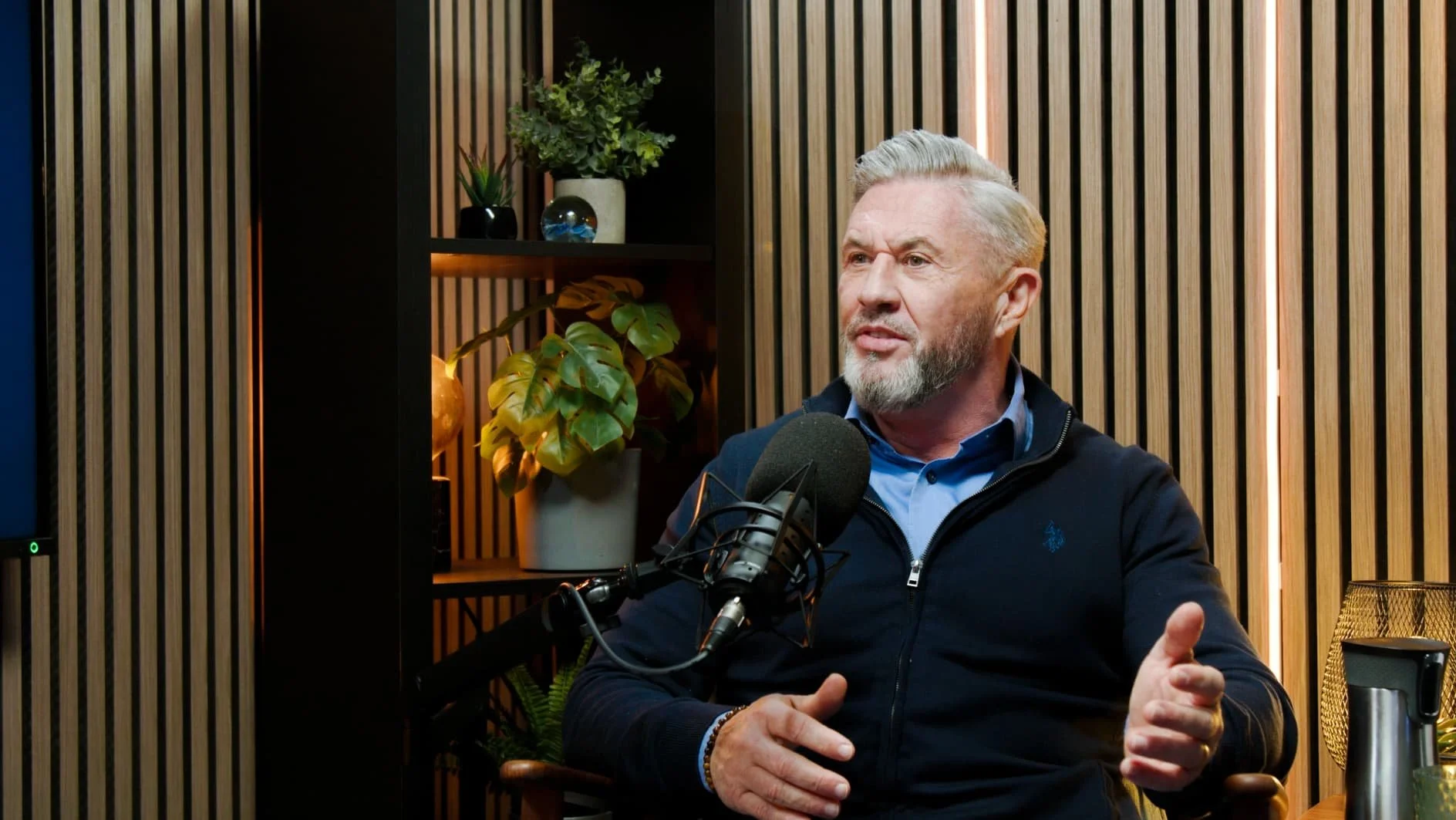
We have up to four Procasters available per session, all on boom arms with pop filters, positioned so you can speak naturally without thinking about mic technique.
The mixer: RODECaster Pro
The RODECaster Pro is what ties everything together. It's an all-in-one podcast production mixer that handles audio routing, live mixing, effects processing, and recording — all in a single unit.
With the RODECaster Pro, you can replace an entire roomful of expensive and complicated equipment with a single, intuitive device that does it all. RØDE
What it actually does:
Routes each microphone to its own independent channel with separate gain control
Applies real-time compression, EQ, and limiting to each voice so levels stay consistent
Records each mic to a separate track, giving editors full control in post-production
Handles remote guest audio via USB or Bluetooth
Provides zero-latency headphone monitoring for every participant
For podcasters used to recording on basic USB setups, the difference is immediately audible. Voices sit cleanly in the mix, background noise is managed before it hits the recording, and the raw files that leave the studio are already 90% of the way to broadcast-ready.
The cameras: 6K sensors, 1080p output
The cameras and switching: two different approaches
At the Podcast Studio Glasgow, we run two purpose-built studios with different video configurations to suit your needs.
psg1 uses 6K cameras routed through an Atem switcher, which downscales the output to 1080p. This setup works well for single-host or two-person recordings where you want clean, broadcast-quality video without massive file sizes.
psg2 takes a different approach. It's built around three Canon 5D Mark IV cameras routed through a RODECaster Video switcher, with Rode Procasters handling the audio. This is our full production studio, and the workflow is designed specifically for professional editing flexibility.
Why three cameras matter: A single static angle makes editing difficult. If someone stumbles over a word, you can't cut it without a visible jump cut. Three cameras — typically a wide shot, a host close-up, and a guest close-up — give your editor proper coverage. You can cut between angles to tighten the conversation, correct mistakes, or add visual variety without making the edit obvious.
The critical advantage: ISO recording. Here's where the setup becomes significantly more valuable than consumer gear. The RODECaster Video doesn't just switch between cameras live — it records ISO files (isolated recordings) from each camera simultaneously.
That means you leave the studio with:
Camera 1 (wide shot) — full uninterrupted recording
Camera 2 (host close-up) — full uninterrupted recording
Camera 3 (guest close-up) — full uninterrupted recording
A switched program output (the live-switched version with synced audio from the Rodcaster Pro)
Separate audio tracks for each microphone
Why ISO files transform the edit: If you only have a switched program output (what most people get when recording directly into cameras or using basic switchers), you're locked into the decisions made during recording. If the camera operator switched to the wrong angle at the wrong time, or missed a reaction shot, that's what you're stuck with.
With ISO files, your editor has every angle from start to finish. They can reconstruct the entire episode in post-production, choosing the best angle for every moment, cutting out mistakes across multiple angles, and building a final cut that looks deliberately crafted rather than merely captured.
This is how television is made. It's also how professional podcast studios operate. Recording directly into cameras without ISO capability means you're editing with one hand tied behind your back.
File sizes stay manageable: The 5D Mark IV cameras capture excellent image quality, but by routing through the RODECaster Video and outputting at 1080p, the ISO files remain a practical size. A 45-minute three-camera recording typically generates around 30GB to 40GB total — large, but not the 150GB+ you'd get recording 4K internally to each camera's SD card.
1080p remains the most practical resolution for podcast video distribution, balancing quality with manageable workflow and fast upload times. Mytranscriptionplace
Acoustic treatment: why the room matters
Professional equipment in an untreated room still sounds like an untreated room. The space itself is part of the signal chain.
PSG's studios are acoustically treated with bass traps, acoustic panels, and diffusers to control reflections and eliminate standing waves. This means voices are captured cleanly without the boxy, echoey quality that untreated rooms introduce.
In most home studios, a dynamic microphone combined with light acoustic treatment beats overspending on gear in a bad-sounding room. The Podcast Consultant
You don't need a £10,000 microphone if you're recording in a space that sounds like a bathroom. Conversely, a £200 microphone in a well-treated space will outperform a £2,000 microphone in a poor room every time.
Why this setup works
The equipment at PSG isn't exotic or inaccessible. Rode Procasters, RodeCaster Pro mixers, Canon 5D Mark IV cameras, and the RodeCaster Video switcher are all commercially available and widely used in professional podcast studios.
What makes the difference is how it's configured, how the room is treated, and how the workflow is designed to produce consistent, repeatable results.
If you're evaluating whether to invest in your own setup or record in a studio, here's the honest breakdown:
DIY at home:
£500 to £1,500 for decent equipment (mic, interface, headphones, boom arm)
Cameras, switcher, and multi-angle setup: another £2,000 to £5,000
Acoustic treatment adds another £200 to £500
Learning curve to use it all properly: significant
Result: workable, but inconsistent depending on your skill level and environment
No ISO files unless you invest in professional switching hardware
Professional studio (PSG):
£75 per hour
Multi-camera video with ISO files, broadcast audio, separate tracks, treated room, all included
Zero learning curve — you show up, record, leave with professional files
Result: consistent, repeatable, broadcast-ready every time with full editorial flexibility
For most podcasters, the maths is straightforward. If you're recording monthly, £75 per session is £900 per year — significantly less than the cost of buying and learning to use professional equipment yourself, and with none of the risk of substandard results or locked-in camera angles.
The transparency advantage
One reason the Podcast Studio Glasgow publishes this level of detail is that transparency builds trust. Most studios keep their equipment vague or hidden. We tell you exactly what we use, why we use it, and what you're paying for.
If you're trying to decide whether studio recording makes sense for your podcast, understanding what professional equipment actually does — and what it costs to access it — makes that decision clearer.
Book a session at £75 per hour at podcaststudioglasgow.com, or get in touch if you want to discuss your specific setup needs before committing.
Podcast Studio Glasgow | 279 Abercromby Street, Glasgow | podcaststudioglasgow.com