The Unfair Advantage: Why Every Business Coach and Leadership Expert Needs a Podcast (And Why Your Competitors Won't Have One)

You've built a solid business. You coach clients. You get results. You know your stuff better than most people in your field.

But here's the problem: nobody outside your existing network knows that.

You're competing with coaches who have bigger budgets, flashier websites, and more social media followers. You're fighting for visibility in a market saturated with "thought leaders." Your LinkedIn posts get decent engagement. Your email list grows slowly. Your speaking gigs come through referrals.

And it's exhausting.

But there's a specific, underutilised weapon that business coaches and leadership experts are sleeping on. It's not new. It's not trendy. But it's absolutely lethal for building personal authority and filling your coaching pipeline.

It's a podcast.

Not because podcasting is "hot right now." But because of what a podcast actually does for a coaching or leadership expert's business. And for some context, check out what The Power Within’s James Fleming has to say about his podcast.

1960s DC comic book cover style illustration. Bold, dynamic composition showing a determined business leader

Why Podcasts Work Where Everything Else Fails for Coaches

Let's be honest about your current authority-building strategy. You've probably invested in:

  • LinkedIn content (algorithm is brutal, reach is declining)

  • Your website and blog (nice to have, but clients don't find you there)

  • Speaking events (once every few months, the audience forgets you in weeks)

  • Email newsletters (assumes you already have an audience)

  • Paid ads (expensive, requires constant optimisation)

All of these have the same problem: they're push channels. You're creating content and hoping it reaches people. You're fighting for attention in an oversaturated space.

A podcast is different. It's a pull channel. People choose to listen to you. Repeatedly. Every week. And for a business coach or leadership expert, that repeated exposure is everything.

Here's why:

People don't hire coaches they don't trust. They don't trust people they don't know. Podcasts solve the "know" problem faster than anything else.

When someone listens to your podcast for three months (12 episodes, assuming a weekly release schedule), they've spent 10+ hours inside your thinking. They've heard how you approach problems. They've noticed your biases. They've watched you navigate tough questions. They know whether you're genuine or full of it. And a quick sidebar: if you’re wondering how long your podcast episodes should be, we have a guide on that.

By the time they consider hiring you, they've already decided you're worth talking to. The sales conversation becomes "let's work together" not "convince me you're legit."

That's not a small thing. That's the entire game.

If you’d like this guide in a handy, 11-slide PDF download, just click here.

The Real Math: Lead Generation Through Podcasting

Here's what actually happens when you run a podcast as a business coach for 12 months, assuming consistent weekly recording and proper promotion:

Metric Conservative Realistic Strong Growth
Episodes (per year) 48 48 52
Downloads per episode (avg) 350 800 1,200
Total downloads (year) 16,800 38,400 62,400
Unique listeners (est.) 2,500 5,000 8,000
Warm leads (5-10% interested) 125 400 720
Coaching enquiries (10-20% book consultation) 13 60 144
Conversion to clients (30-50% of warm leads) 4 18 43
Average client value £3,000 £3,500 £5,000
Revenue generated £12,000 £63,000 £215,000
Annual podcast cost £3,000 £5,000 £8,000
Net ROI 300% 1,160% 2,588%

Breakdown: Conservative scenario assumes minimal promotion. Realistic scenario assumes consistent LinkedIn and email promotion. Strong Growth assumes guest appearances, clips, and cross-promotion. All scenarios assume professional recording quality and weekly consistency.

Most coaches think about their business like this:

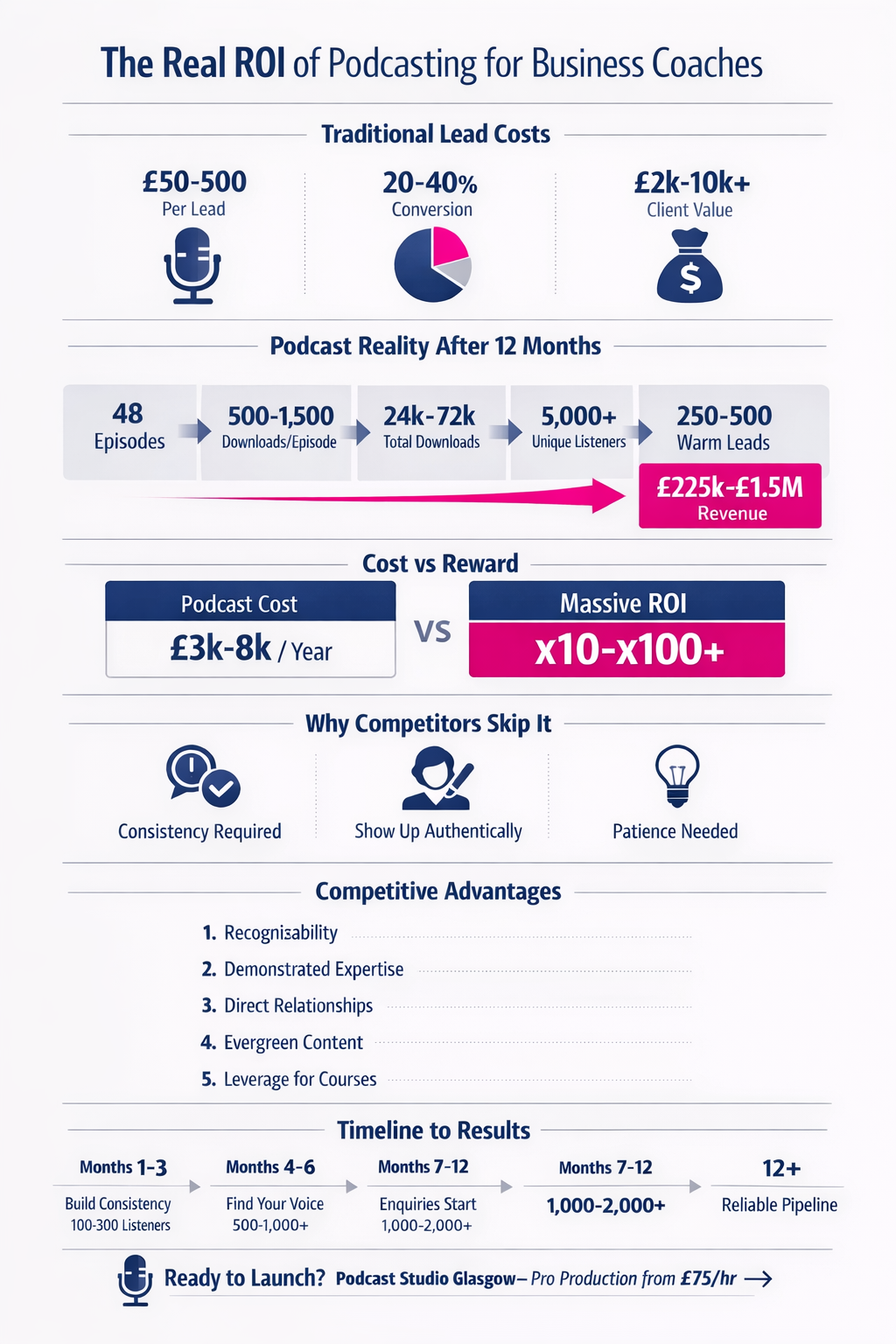
  • Cost per lead (ads, networking, events): £50-500 per qualified lead

  • Sales conversation conversion: 20-40%

  • Average client value: £2000-10,000+

Then they ask: "What's the ROI on a podcast?"

And the answer depends on how you build it.

Here's what actually happens when you run a podcast as a business coach for 12 months:

You record weekly. Let's say 48 episodes (allowing for breaks).

By month 6, you're getting 200-500 downloads per episode (modest, realistic numbers for a new show).

By month 12, if you're promoting properly, you're at 500-1500+ downloads per episode.

Over a year, that's 24,000 - 72,000+ downloads. Not all of those are unique listeners—some are repeats—but let's say you get 5,000 unique listeners minimum.

Of those 5,000, maybe 5-10% are genuinely interested in what you do: 250-500 warm leads.

Of those warm leads, maybe 10-20% book a consultation: 25-100 new coaching enquiries per year.

If your average client value is £3,000+, and your close rate on warm leads is 30-50% (higher than cold), you're looking at £225,000 - £1,500,000 in potential revenue generated.

Cost of running a podcast for a year? £3,000-8,000 if you're doing it professionally (studio time, editing, hosting, promotion).

That's not just good ROI. That's absurd ROI.

And that's the conservative scenario. We've worked with coaches who've built podcasts and filled their entire coaching pipeline through listener enquiries within 18 months.

Here's what actually happens when you run a podcast as a business coach for 12 months, assuming consistent weekly recording and proper promotion:

Why Your Competitors Won't Do This (Even Though They Should)

Here's the uncomfortable truth: most of your competitors will never start a podcast.

Not because they don't know about it. But because:

  1. It requires consistency. Weekly episodes, for months, before you see real traction. Most people can't commit to that. They'd rather chase shiny tactics that feel productive immediately.

  2. It requires showing up as yourself. You can't hide behind a polished LinkedIn article or a carefully-crafted tweet. You have to think out loud, admit what you don't know, be genuinely helpful. That's terrifying for some people.

  3. It requires patience. You won't see 100 coaching enquiries from your podcast by episode 3. Most people quit before they see results because they're measuring wrong.

That's actually perfect for you. Because while they're distracted by the latest social media trend, you're building something that compounds.

Podcast_ROI_for_Business_Coaches.pptx by Mark & Cam - Podcast Studio Glasgow

The Competitive Advantage You're Not Using

Here's what happens when you build a podcast as a business coach:

First, you become recognisable in your niche. Your ideal clients start hearing your name repeatedly. Not from ads. From word of mouth. "You should listen to [your name]'s podcast, they talk about exactly this."

Second, you establish expertise without claiming it. You're not saying you're an expert. You're demonstrating it. Every episode shows how you think about problems in your field. That's more credible than any LinkedIn bio.

Third, you build a direct relationship with prospects. They hear your voice. They get your perspective. They start to like you. By the time they consider hiring a coach, you're already the obvious choice.

Fourth, you create content that works for years. A podcast episode from year one is still generating downloads in year three. Your LinkedIn post from today will be invisible in a month. Your podcast is an asset that compounds.

Fifth, you create leverage. Once you have an audience, you can:

  • Sell online courses

  • Offer group coaching

  • Partner with other experts

  • Speak at events (now you have credibility)

  • Get media appearances

  • Write that book with an actual platform

A podcast isn't just a lead generation tool. It's a foundation for everything else.

What Business Coaches Get Wrong When Starting

We've worked with dozens of coaches building podcasts. And we see the same mistakes:

Treating it like a hobby. Recording when you feel like it. Taking two-month breaks. Publishing inconsistently. This kills momentum and listener trust. Commitment matters more than perfection.

Focusing on downloads instead of depth. You don't need 10,000 downloads per episode. You need 100 deeply engaged listeners who trust you enough to book a consultation. The quality of the audience matters more than the size.

Not promoting. You record a great episode and publish it. Nothing happens. Then you blame podcasting. The truth: 80% of the work is promotion. Getting your episode in front of people who care. Repurposing clips. Mentioning it in emails. Link to it in your bio.

Wrong guest strategy. Some coaches interview random "successful people." But you should interview people your ideal clients aspire to be like, or people who serve your ideal clients. The right guests bring their audiences. The wrong guests bring nobody.

Poor production quality. You don't need a £10,000 studio. But you do need broadcast-quality audio. Listeners will forgive a less-polished format, but they won't forgive poor sound. Bad audio signals you don't care. And that kills credibility.

No clear positioning. "I talk about leadership" is too broad. "I help mid-market CEOs delegate better so they actually have time for strategy" is specific. Specificity attracts the right listeners. Generality attracts nobody.

The Format That Actually Works for Coaches

You don't have to do interviews. You don't have to do long solo monologues. Here's what actually works:

Solo episodes (30-40 minutes) where you answer real client questions. Your clients ask you the same things repeatedly. That's your podcast content. Specific problems. Specific solutions. Specific results.

Guest interviews (45-60 minutes) with complementary experts. Not famous people. People whose audiences overlap with your ideal clients. A talent acquisition expert if you coach on team building. A CFO if you coach on business growth.

Narrative storytelling (20-30 minutes) from your own coaching work. Real situations you've navigated. Real problems you've solved. Real outcomes. (Obviously anonymised. Confidentiality first.)

Panel discussions (45-60 minutes) where you debate ideas with other coaches. This builds community and positions you as the natural leader in the conversation.

The best approach? Mix all four. Keeps it fresh. Keeps your audience engaged.

The Timeline to Real Results

This is important, so pay attention:

  • Months 1-3: You're establishing consistency. Recording weekly. Building a small audience (100-300 listeners). Getting comfortable on the mic.

  • Months 4-6: You're finding your voice. Episodes are getting better. You're starting to get repeat listeners (500-1000 per episode).

  • Months 7-12: You're starting to see real enquiries. Not floods. But genuine warm leads from listeners. Your audience is growing predictably (1000-2000+ per episode).

  • Month 12+: Your podcast is a reliable lead generation channel. It's part of your marketing stack. New coaches in your niche are probably starting their own, wishing they'd started a year ago.

This assumes you're:

Miss any of those, and the timeline stretches. But if you get them right, this is realistic.

infographic explaining the business benefits of a podcast for business leaders

The Decision Point

Here's what separates coaches who build real authority from coaches who spin their wheels:

It's not talent. It's not experience. It's not budget.

It's commitment to one consistent channel instead of chasing 47 different tactics.

Every week for a year. That's the ask. 48 episodes. Consistency. Quality. Promotion.

In 12 months, you'll have either:

A) A reliable lead generation channel that fills your coaching pipeline. A platform that compounds in value. Authority in your niche that took years to build through other methods. Leverage for everything else you want to do.

Or

B) Another abandoned project. Another "I tried podcasting, and it didn't work." More frustration.

The difference isn't luck. It's showing up.

Ready to launch?

If you're serious about building a podcast as a business coach or leadership expert, the technical side shouldn't be the barrier. You focus on your content. Let professionals handle the recording and production.

Podcast Studio Glasgow works with coaches and experts building personal authority. We handle:

  • Professional recording in broadcast-quality studios

  • Live video production if you want video alongside audio

  • Post-production editing and optimisation

  • Technical guidance on format, pacing, and guest management

Book a session from £75/hour to record your first batch of episodes, or get in touch to discuss your show format and strategy.

Most successful coaches wish they'd started their podcast sooner. And remember, this guide is available as a simple 11-slide PDF you can grab here.

Don't be the one wishing that a year from now. And if you’d like a free eBook on how to start a successful business podcast, grab ours here.

Mark Hunter

Mark is the founder of Postable Limited and the co-founder of the Podcast Studio Glasgow. He became a pioneer of podcasting in 2005 and has worked extensively as a podcast producer, digital marketing consultant and content creator.

https://podcaststudioglasgow.com
Next
Next

Best Podcasts Made in Scotland (2026 Listening Guide)

The Podcast Studio Glasgow

Studio recording from £75/hour | Book online today

Location

Rooms 109, 110 & 111, Abercromby Business Centre

279 Abercromby Street

Glasgow G40 2DD

0141 459 0956

The Podcast Studio Glasgow is a trading name of Postable Limited SC417402

find us on the socials

Metric Conservative Realistic Strong Growth
Episodes (per year) 48 48 52
Downloads per episode (avg) 350 800 1,200
Total downloads (year) 16,800 38,400 62,400
Unique listeners (est.) 2,500 5,000 8,000
Warm leads (5-10% interested) 125 400 720
Coaching enquiries (10-20% book consultation) 13 60 144
Conversion to clients (30-50% of warm leads) 4 18 43
Average client value £3,000 £3,500 £5,000
Revenue generated £12,000 £63,000 £215,000