
Do You Need a Microphone Gain Booster? (Cloudlifter vs Budget Alternatives)
You've bought a Shure SM7B or Rode Procaster for your podcast.
You plug it in. The audio is weak, quiet, and hissy. Your interface gain is maxed out, and it's still not loud enough.
Welcome to the low-output dynamic microphone problem, and why gain boosters exist. (And Joe Rogan uses the Shure SM7B, but you may not want it in your podcast kit.)

Do You Need a Microphone Gain Booster? (And Which One Actually Works)
If you're using a dynamic microphone - Shure SM7B, Rode Procaster, Electro-Voice RE20 - you've probably discovered that it needs significant gain to reach usable recording levels. Your audio interface provides 50-60 dB of preamp gain, but these mics often require 60-70 dB to sound good. Push your interface that hard and you introduce noise, hiss, and a thin, brittle sound.
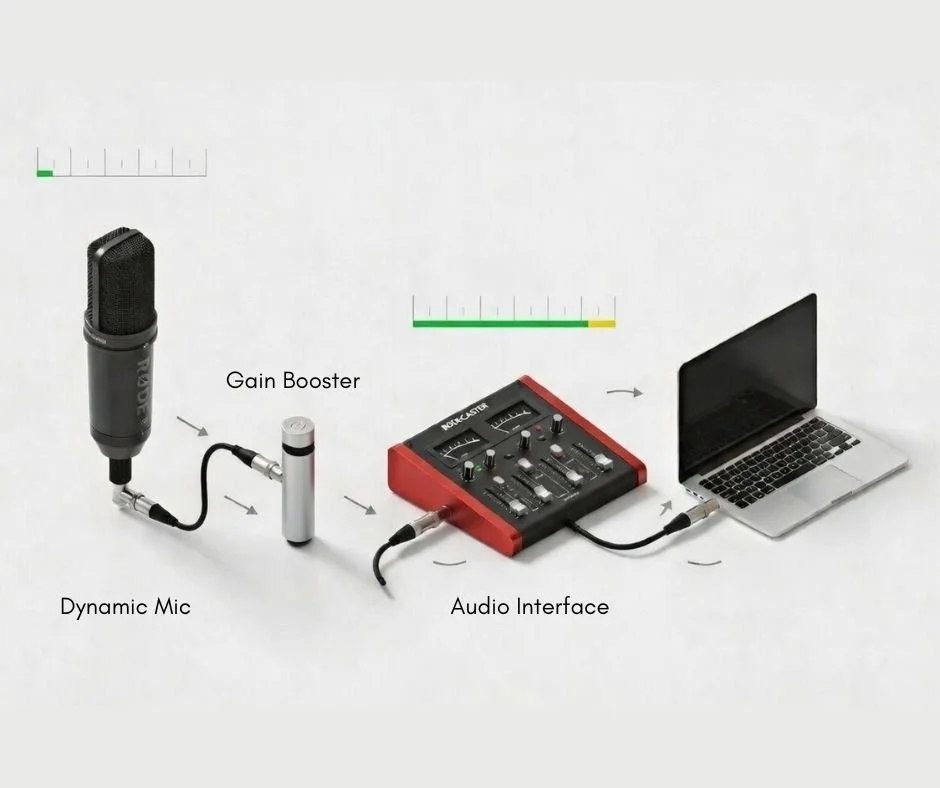
The solution: an inline mic gain booster (also called a mic activator or inline preamp). These small devices sit between your microphone and audio interface, adding 20-30 dB of clean, low-noise gain before the signal ever reaches your preamp. Result: you can run your interface at 40-50% gain instead of 90-100%, which produces cleaner, quieter, more professional audio.
At Podcast Studio Glasgow, we use SubZero Single Channel Microphone Boosters (£30 each, bought in bulk). They're not the industry standard Cloudlifter CL-1 (£150), but they do the same job at a fraction of the cost.
Here's how gain boosters work, when you actually need one, and which options deliver the best value.
The Problem: Why Dynamic Mics Need Extra Gain
Dynamic microphones use a moving coil design that makes them robust, noise-rejecting, and ideal for podcasting. The trade-off? They have much lower output sensitivity than condenser mics.
Typical sensitivity ratings:
Shure SM7B: -59 dB (very low)
Rode Procaster: -56 dB (low)
Electro-Voice RE20: -56.5 dB (low)
Condenser mic (for comparison): -35 to -45 dB (much higher)
Translation: dynamic mics produce a weaker electrical signal. To bring that signal up to proper recording levels (around -12 dB to -6 dB peaks), you need significant amplification — often 60-70 dB of gain.
What happens when your interface can't deliver clean gain:
Noise floor rises: Pushing preamps to 90-100% introduces audible hiss
Signal becomes thin: Insufficient headroom makes voices sound brittle and weak
Dynamic range suffers: Quiet passages get lost in noise, loud passages distort
This is why Joe Rogan's SM7B setup includes high-end preamps. It's why podcasters spend £150 on Cloudlifters. And it's why we bulk-buy £30 SubZero boosters at PSG — they solve the gain problem without the premium price.
Sources: The Seasoned Podcaster FetHead vs Cloudlifter, Cloudlifter Alternatives Roundup
How Gain Boosters Work
Mic gain boosters are inline preamps powered by phantom power (+48V from your audio interface or mixer). They sit between your microphone and interface, adding clean gain before the signal reaches your main preamp.
The signal chain:
The microphone produces a low-output signal
Gain booster adds 20-30 dB of clean amplification
Boosted signal reaches your interface preamp
Interface preamp adds final 30-40 dB (instead of 60-70 dB)
Result: cleaner audio with lower noise floor
Critical detail: Gain boosters require phantom power to operate, but they don't pass phantom power through to the microphone. This protects ribbon mics (which can be damaged by phantom power) while still allowing the booster to function.
What they do:
Add 20-30 dB of transparent gain
Lower your interface's noise floor (by reducing required preamp gain)
Improve dynamic range and headroom
Make low-output mics usable with budget interfaces
What they don't do:
Change the sound of your microphone (they should be transparent)
Replace the proper acoustic treatment
Fix a bad recording environment
Add compression, EQ, or other processing
When You Actually Need a Gain Booster
You need a gain booster if:
Your interface gain is at 80-100%, and the audio is still too quiet
You hear a hiss or noise when pushing the preamp gain
You're using a low-output dynamic mic (SM7B, Procaster, RE20) with a budget interface
Your interface provides less than 60 dB of clean gain
You probably don't need one if:
Your interface has high-quality preamps with 60+ dB of clean gain (Universal Audio Apollo, Focusrite Clarett+)
You're using a condenser microphone (they have higher output)
You're using a USB dynamic mic with built-in preamp (Shure MV7, Samson Q2U)
Your audio levels are already healthy at 50-60% interface gain
Quick test: Record a test clip with your microphone 2-4 inches from your mouth. If your interface gain is above 70% and peaks are still below -18 dB, you need more gain. A booster solves this.
The Market: From £30 Budget to £150 Industry Standard
Gain boosters range from £30 (SubZero) to £150+ (Cloudlifter, Royer dBooster). All fundamentally do the same thing: add clean gain via phantom power. The differences lie in build quality, gain amount, features, and brand reputation.
The Industry Standards
Cloudlifter CL-1 (£130-150)
Gain: +25 dB
Design: Two-stage adaptive gain (adjusts to mic output)
Size: Larger footprint (requires two XLR cables)
Reputation: Most popular, seen as the "safe" choice
Pros: Proven reliability, excellent build quality, adaptive impedance loading
Cons: Expensive, larger than alternatives, no more transparent than cheaper options
Triton Audio FetHead (£65-85)
Gain: +27 dB (slightly more than Cloudlifter)
Design: Tiny inline design (connects directly to mic or interface)
Size: Compact (barely noticeable when attached)
Pros: Half the price of Cloudlifter, extra 2 dB gain, ultra-portable
Cons: Fixed gain (doesn't adapt like Cloudlifter), some report slight tonal colouration in low-mids
Sources: Kettner Creative Cloudlifter vs FetHead, Crumplepop FetHead vs Cloudlifter Comparison
The Budget Option
SubZero Single Channel Microphone Booster (£25-35)
Gain: +30 dB (most gain of any booster)
Design: Similar footprint to Cloudlifter, all-metal construction
Size: Standard inline preamp size (requires two XLR cables)
Pros: Cheapest option, highest gain, does the job for significantly less money
Cons: Less refined than Cloudlifter/FetHead, occasional quality control issues (some units fail early), visually mimics Cloudlifter design
Real-world PSG experience: We've used SubZero boosters across 4x Rode Procasters for 3+ years. Buy them in bulk (4-6 units), expect 1-2 to fail within 18 months, replace cheaply. Total cost over 3 years: ~£120 for 6 units. Cloudlifter equivalent: £600-900 for 4x CL-1 units. The SubZeros aren't boutique, but they work.
Sources: Amazon UK SubZero MB-1 Reviews, Gearspace SubZero Thread
| Model | Gain | Price (UK) | Size | Best For |
|---|---|---|---|---|
| Cloudlifter CL-1 | +25 dB (adaptive) | £130-150 | Larger (requires 2 XLR cables) | Industry standard, proven reliability, adaptive gain |
| Triton FetHead | +27 dB (fixed) | £65-85 | Tiny (connects directly to mic) | Best value-for-money, portable, extra 2 dB gain |
| SubZero MB-1 | +30 dB | £25-35 | Standard (requires 2 XLR cables) | Budget setups, bulk purchases, maximum gain |
| Radial McBoost | +20/+25/+30 dB (switchable) | £140-160 | Larger (requires 2 XLR cables) | Advanced users wanting switchable gain & impedance |
| sE Electronics Dynamite | +28 dB | £75-95 | Compact (connects directly to mic) | Middle ground between FetHead and Cloudlifter |
Which One Should You Buy?
If budget isn't a constraint: Cloudlifter CL-1 (£130-150)
The industry standard. Adaptive two-stage gain, excellent build quality, proven reliability. Buy it, forget about it, it'll last decades.
If you want best value: Triton Audio FetHead (£65-85)
Half the price of Cloudlifter, 2 dB more gain, ultra-portable. The smart choice for most podcasters. Slight tonal colouration in low-mids is negligible for speech.
If you're on a tight budget: SubZero MB-1 (£25-35)
Does the job for a third of the Cloudlifter's price. Expect occasional quality control issues (buy spares), but for home studios and beginner setups, it's hard to argue with the economics.
If you need flexibility: Radial McBoost (£140-160)
Switchable gain levels (+20/+25/+30 dB) and impedance loading options. For advanced users who want to fine-tune mic response, but overkill for most podcasters.
What we use at PSG: SubZero boosters on all our mics. Total investment: ~£120-140 over 3 years (buying 6 units, replacing failures). Equivalent Cloudlifter setup: £520- £ 600.
The SubZeros work. They're not boutique. But for a studio where gear gets used daily by multiple clients, the economics make sense.
Sources: Podcastage Mic Activator Comparison, The Seasoned Podcaster Cloudlifter Alternatives
How to Use a Gain Booster Properly
Setup:
Connect the microphone (XLR) to the gain booster input
Connect the gain booster output (XLR) to the audio interface mic input
Enable +48V phantom power on your interface
Set interface gain to 40-50% (instead of 80-100%)
Test and adjust
Critical mistakes to avoid:
Don't bypass phantom power: Gain boosters need +48V to operate (they won't work without it)
Don't daisy-chain multiple boosters: One is enough, stacking adds noise
Don't expect miracles in bad rooms: Gain boosters add clean amplification, they don't fix echo or room noise
Don't ignore your interface gain: You still need to set proper levels (peaks around -12 dB to -6 dB)
Expected results:
Interface gain drops from 80-90% to 40-50%
Noise floor decreases noticeably
Audio sounds fuller, cleaner, and more professional
Headroom improves (more dynamic range between quiet and loud passages)
Do You Actually Need One?
Skip the gain booster if:
You have a high-end interface (UA Apollo, Focusrite Clarett+, SSL2+) with 60+ dB clean gain
Your current setup already produces clean audio at 50-60% gain
You're using a condenser microphone (they don't need boosters)
You're using a USB dynamic mic with built-in preamp (Shure MV7, Samson Q2U)
Buy a gain booster if:
You're using SM7B/Procaster/RE20 with a budget interface (Focusrite Scarlett 2i2, PreSonus AudioBox)
Your interface gain is maxed and audio is still too quiet
You hear hiss when recording at high gain levels
You want cleaner, more professional audio without upgrading your entire interface
The Podcast Studio Glasgow setup: Rode Procaster mics + SubZero boosters + RODECaster Pro mixer. We could use Cloudlifters (and the audio wouldn't sound noticeably different), but spending £600 on 4x Cloudlifters when £140 on 6x SubZeros does the same job doesn't make financial sense for a working studio.
Final Recommendation
If you're using a low-output dynamic microphone (SM7B, Procaster, RE20) with a budget-to-mid-tier audio interface, yes, you need a gain booster. The question is which one.
Best overall value: Triton Audio FetHead (£65-85)
Half the price of Cloudlifter, 27 dB gain, ultra-portable. The smart choice for 90% of podcasters.
Best for reliability: Cloudlifter CL-1 (£130-150)
If you want zero-risk, buy-it-for-life reliability, this is it. Resale value holds strong.
Best for tight budgets: SubZero MB-1 (£25-35)
Does the job. Not boutique, occasional QC issues, but at a third of the Cloudlifter's price, it's hard to argue. Buy spares.
At Podcast Studio Glasgow, we use SubZero boosters across all Procaster setups. They've powered thousands of podcast episodes over 3+ years. The audio quality is identical to what we'd get with Cloudlifters — because gain boosters, when functioning properly, are transparent. The only difference is we've spent £120 instead of £600 on the same result.
Don't let gear snobbery convince you that expensive is always better. Dynamic mics need extra gain. Gain boosters provide it. Buy what fits your budget, then focus on what actually matters — recording consistently, improving your content, and building an audience.
Sources:
The Seasoned Podcaster, "FetHead vs Cloudlifter: Mic Activator Head to Head" (https://www.theseasonedpodcaster.com/gear/fethead-vs-cloudlifter/)
Crumplepop, "FetHead vs Cloudlifter: Which is Best for You?" (https://crumplepop.com/fethead-vs-cloudlifter-which-is-best-for-you/)
Kettner Creative, "Cloudlifter Vs Fethead | BEST Inline Preamp?" (https://kettnercreative.com/inline-preamp/cloudlifter-vs-fethead/)
Podcastage, "Cloudlifter vs. Fethead vs. SS1 vs. Durham vs. McBoost Comparison" (https://podcastage.com/rev/micactivators)
The Seasoned Podcaster, "Cloudlifter Alternatives - Our Gain Booster Roundup" (https://www.theseasonedpodcaster.com/gear/cloudlifter-alternatives/)
Amazon UK, "SubZero MB-1 Microphone Booster Preamp" customer reviews (https://www.amazon.co.uk/SubZero-MB-1-Microphone-Booster-Preamp/dp/B09JKMXWBW)
Gearspace, "Anyone tried the SubZero SZ-MA1 (cheap Cloudlifter)?" forum thread (https://gearspace.com/board/so-much-gear-so-little-time/1232150-anyone-tried-subzero-sz-ma1-cheap-cloudlifter.html)