
Corporate Podcast Production in Scotland: What £300/Month Actually Gets You
Corporate podcasting can seem expensive until you factor in what the alternative actually costs.
Most organisations approach internal podcasting the same way: "Can't we just record this on Teams and have someone edit it?" The answer is yes, you can. The better question is whether you should.
Here's what professional podcast production actually delivers, and why the math makes more sense than you think.
Professional Production: What You Actually Receive
One hour of professional studio recording at Podcast Studio Glasgow costs £140. Post-production (editing, mastering, and content creation) costs £150-£200 per episode. Let's break down exactly what £290-£340 per episode delivers:
One fully produced episode
Recorded, edited, mastered to broadcast standards, and delivered as publication-ready files. You receive WAV files (archival quality), MP3 files (distribution), and polished video files ready to upload to YouTube, LinkedIn, or your website.
Professional audio that meets platform standards
Recording levels between -12dB and -6 dB. 48kHz/24-bit capture. Mastered to -16 LUFS for consistent loudness across Spotify, Apple Podcasts, and YouTube. Noise floor below -45dB. These aren't optional specs, they're the baseline for professional audio that doesn't make listeners click away within 30 seconds.
Three-camera video recording
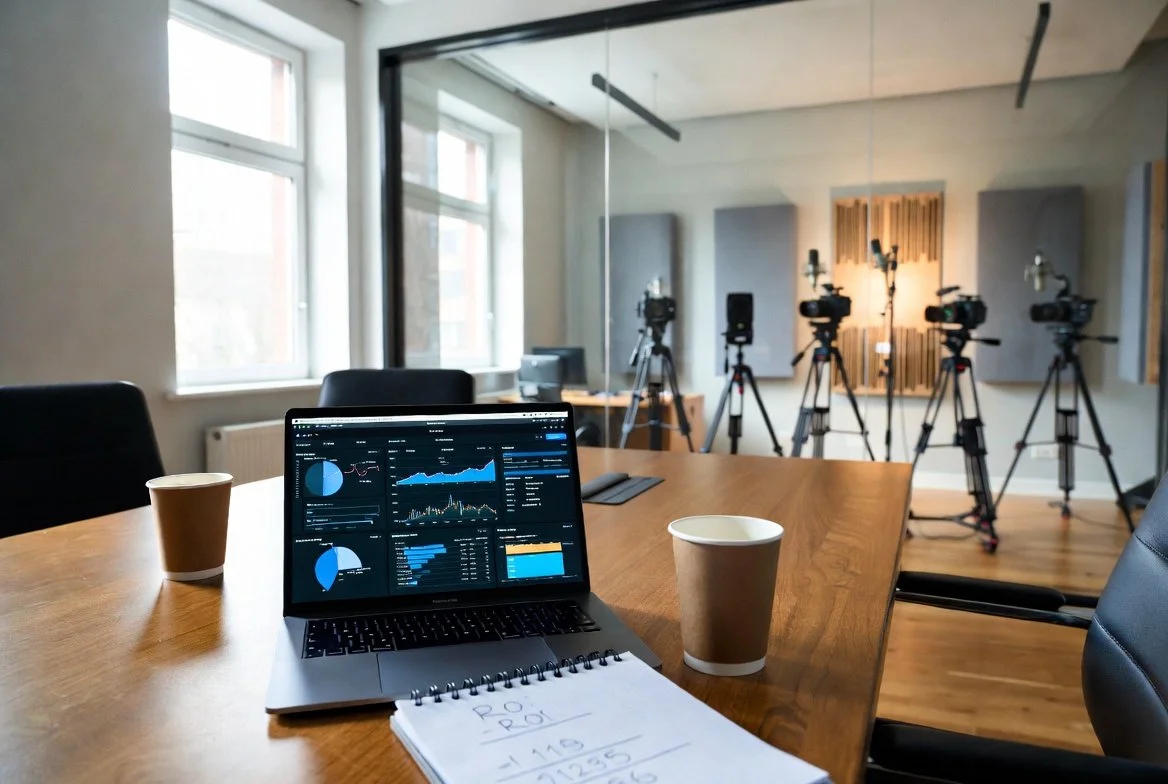
Blackmagic 6K cinema cameras capture multiple angles simultaneously. This produces content for YouTube, LinkedIn, website embeds, and social media. One recording session generates assets for multiple distribution channels, not just a single audio file.
Three short social videos
30-90 second clips optimised for LinkedIn, Twitter, Instagram, and Facebook. These clips drive traffic back to full episodes and extend the reach of each recording beyond podcast platforms. Each clip is edited, captioned, and formatted for the specific platform.
Full text transcript
Complete transcription of the episode suitable for creating blog posts, show notes, social media quotes, or accessibility requirements. This transcript becomes the foundation for repurposing your content across multiple formats without additional transcription costs.
Your specific edit requests have been implemented
Remove that section where someone coughed. Cut the tangent that didn't land. Tighten the pacing in the middle segment. Your edit requests are included in the post-production package, not charged as revisions.
The Real Cost: Four Episodes Per Month
Let's assume a typical corporate podcast publishing schedule of four episodes per month (weekly release). Here's the actual investment:
Recording: 4 hours at £140/hour = £560
Post-production: 4 episodes at £150-£200 = £600-£800
Monthly total: £1,160-£1,360
For many organisations, this feels significant. So let's compare the cost of the DIY alternative.
The Hidden Cost of "Just Recording on Teams"
Let's calculate the actual cost of internal production for your organisation.
Equipment investment: £900-£2,600
Quality microphones, audio interfaces, acoustic treatment, and video lighting. This is the upfront cost before you record a single episode. Cheaper equipment produces audio that signals "we didn't take this seriously," which undermines the content before anyone hears it.
Learning curve: 40-60 hours
Someone on your team needs to learn the basics of audio engineering, video editing, file management, compression settings, colour grading, and platform-specific upload requirements. At an average organisational salary of £35,000, that's approximately £840-£1,260 in lost productivity before you've recorded anything.
Editing time per episode: 4-6 hours
Removing filler words, adjusting audio levels, colour grading video, syncing tracks, adding intro/outro music, creating three social clips, formatting transcripts, implementing edit requests, and uploading to platforms. This isn't simple "trim the beginning and end" editing - it's full post-production to match professional standards.
Four episodes per month: 16-24 hours of editing time
At a £35,000 average salary (£16.83/hour): £269-£404 per month in internal editing time. But this assumes your team member can edit at professional speed once they have cleared the learning curve. Realistic editing time for someone doing this occasionally is 6-8 hours per episode, which is 24-32 hours per month, at £404-£538.
Transcription services: £80-£160 per month
If you're outsourcing transcription (which most organisations do because manual transcription takes 4-6 hours per hour of audio), you're paying £20-£40 per episode. Four episodes: £80-£160 monthly.
Inconsistent quality and re-records
Background noise bleeds through on Teams calls. Internet drops mid-sentence. Audio levels mismatch between participants. Someone's video freezes at a crucial moment. Each quality issue extends editing time or requires re-recording, which requires re-coordinating everyone's calendars.
Opportunity cost of coordination
Weekly recording sessions mean weekly calendar coordination. Four separate scheduling efforts per month versus one or two batch sessions. The administrative overhead alone costs hours that could be spent on content strategy instead of calendar management.
Monthly DIY cost after first year:
Editing time: £404-£538
Transcription: £80-£160
Equipment maintenance/replacement: £50-£100 (averaged)
Software subscriptions: £30-£60
Total: £564-£858 per month
First year, including setup costs:
Equipment: £900-£2,600
Learning curve: £840-£1,260
Monthly costs (×12): £6,768-£10,296
Total first year: £8,508-£14,156
And the quality still won't match professional studio output.
What Professional Production Actually Solves
Consistency that survives staff changes
When the person who "knows how to edit the podcast" leaves your organisation, your podcast doesn't collapse. The studio provides institutional continuity independent of internal personnel changes.
Time efficiency for your team
Your team spends one hour recording instead of 16-24 hours recording, editing, troubleshooting, and uploading. That's 15-23 hours per month back to strategic work, rather than technical execution.
Professional quality that matches your brand
Your organisation's annual report doesn't look like it was designed in Microsoft Word. Your website doesn't look like a 2003 GeoCities page. Why would your podcast sound like a phone call from 1997? Professional production maintains brand consistency across all channels.
Immediate publication readiness
Files delivered in correct formats, at correct specifications, ready to upload. No internal back-and-forth about file compression, sample rates, or why the episode sounds quiet compared to other podcasts. No learning which export settings YouTube prefers versus LinkedIn.
Multi-channel content from a single recording
One studio session produces: full podcast episode (audio), YouTube video (long-form), LinkedIn video (optimised format), three social clips (platform-specific), full transcript (blog foundation), show notes framework. DIY recording produces raw files that then require 20+ hours of work to repurpose effectively.
The Batch Recording Advantage
Most organisations find that recording two episodes in a single two-hour session is highly efficient. Instead of coordinating four separate one-hour sessions per month, you coordinate two two-hour sessions.
Option 1: Four separate one-hour sessions
Recording: £560 (4 × £140)
Post-production: £600-£800 (4 × £150-£200)
Monthly total: £1,160-£1,360
Option 2: Two batch sessions (2 episodes each)
Recording: £560 (4 × £140, but fewer coordination efforts)
Post-production: £600-£800 (4 × £150-£200)
Monthly total: £1,160-£1,360
But with half the scheduling overhead
The cost is identical, but the operational burden drops significantly. Two calendar coordination efforts instead of four. Two studio visits instead of four. This is the structure that creates sustainability.
The Real Comparison: Internal Resources vs Professional Studio
| Approach | Monthly Cost | Monthly Time | Quality Consistency | Scalability |
|---|---|---|---|---|
| DIY Internal (post setup) | £564–£858 | 16–24 hours | Variable | Difficult |
| Professional Studio | £1,160–£1,360 | 4 hours | Guaranteed | Immediate |
Professional production costs £300-£600 more per month than DIY, but saves 12-20 hours of internal time. At average organisational salary rates, that time saved is worth £202-£336 per month.
Net additional cost: £0-£300 per month for guaranteed professional quality
When DIY Makes Sense (And When It Doesn't)
DIY internal production might work if:
You have a staff member who genuinely enjoys audio/video editing as part of their role
You're producing one episode monthly (not weekly)
You have a very simple format (solo recording, minimal editing needed)
Audio-only is sufficient (no video requirements)
You have time to absorb the 6-12 month learning curve before quality becomes consistent
Professional production makes sense if:
You're publishing weekly or fortnightly (coordination overhead kills DIY)
You need video content for multiple platforms
Brand consistency matters (you can't accept variable quality)
Your team's time is better spent on strategy than technical execution
You need social clips, transcripts, and multi-platform formatting
You can't risk the podcast initiative failing due to production burden
What Organisations Actually Struggle With
It's rarely the cost. £1,160-£1,360 per month is defensible if the content serves strategic communication goals. What kills corporate podcasts is the operational burden.
Week 1: Record episode, seems manageable
Week 2: Edit from last week took longer than expected, need to record this week's episode, falling behind
Week 3: Still editing week 1, recorded week 2, now need to record week 3, coordination is chaotic
Week 4: Three episodes in various stages of editing, quality is suffering, team is exhausted, "maybe we should pause"
That's the pattern. Not failure from cost, but failure from unsustainable operations.
Professional production removes this failure mode entirely. You record, you receive finished files one week later, you publish. The operational burden stays constant regardless of how many episodes you're behind or ahead.
What You Should Actually Expect
Month One:
Book two two-hour sessions (or four one-hour sessions). Record four episodes with professional guidance on pacing, energy, and content structure. Receive fully edited files within one week per episode. Upload to your chosen platforms using the provided files and transcripts.
Month Two:
Recording feels more natural now. You understand the rhythm. Content improves when you're not focused on technical execution. Files arrive on schedule, publishing becomes routine.
Month Six:
You've published 24 episodes. Your podcast has survived past the point where 78% fail. The monthly rhythm is established. The quality is consistent. The content pipeline is predictable. Your team has spent 24 hours on recording instead of 96-144 hours on recording and editing.
That's the goal. Not perfection in episode one, but sustainability through episode fifty.
The Budget Justification
If you're presenting this to leadership, here's the argument:
Option A: Internal Production
Year one investment: £8,508-£14,156
Ongoing monthly cost: £564-£858
Time commitment: 16-24 hours monthly
Quality: Variable, dependent on individual skill development
Risk: High abandonment rate when staff change or priorities shift
Option B: Professional Production
Year one investment: £13,920-£16,320
Ongoing monthly cost: £1,160-£1,360
Time commitment: 4 hours monthly (recording only)
Quality: Broadcast standard, guaranteed
Risk: Low abandonment rate, institutional continuity maintained
Professional production costs £5,400-£2,200 more in year one, but delivers guaranteed quality and returns 144-240 hours of team time annually. In year two and beyond, the cost difference narrows to £300-£600 monthly while continuing to save 12-20 hours of internal time.
For organisations where staff time costs £20+ per hour, professional production becomes cost-neutral while delivering superior quality and sustainability.
Why This Investment Makes Sense
Professional podcast production isn't an expense. It's the operational structure that prevents your initiative from becoming another abandoned internal project that "seemed like a good idea at the time."
The organisations that succeed with podcasting treat it like any other professional communication channel. You don't ask your marketing team to design your annual report in PowerPoint. You don't host your website on someone's personal laptop. You don't create your brand video on a phone camera with no editing.
Podcasting deserves the same professional infrastructure as every other communication channel your organisation uses. Not because perfection matters, but because consistency and sustainability matter.
£1,160-£1,360 per month provides guaranteed quality, predictable scheduling, and institutional continuity that withstands staff changes and priority shifts.
The alternative costs less upfront and more in the long run.
Book a 30-minute consultation, and we'll walk through exactly what your organisation's podcast production would look like. No pressure, just a transparent breakdown of deliverables, timeline, and costs.
Professional recording: £140/hour
Full post-production: £150-£200/episode
Everything you need to publish with confidence.